You can learn how to study the Bible for yourself
Let me ask you a question: What’s your favorite book? I’m not getting at the “spiritual” answer here – I’m talking about your favorite novel. Think of that novel. Hold it in your mind, with its characters, its setting, its storyline. The parts that make you laugh. The parts that make you cry. That bit in the middle that made you think.
Now imagine that all you know of that book is what other people have told you. You’ve sat in seminars where people who have spent extensive time reading that book tell you about its main character. You’ve read the CliffsNotes. You have a quote or two up on your wall. Maybe you’ve watched a movie based on the book.
But you’ve never actually read it. Not all the way. A little here, a little there. But mostly what you know is just what you’ve heard about it.
Now instead of a novel, it’s a book that contains everything you need for life. It tells you where you came from. Why you exist. What is good, what is not. It explains your suffering, and gives you a reason to hope. It tells you about someone who loves you in a way that you can hardly grasp. It’s not just stories of far away imaginary places. It’s your own history, your past, your present, your future.
Wouldn’t you want to read it yourself?
You know exactly where I’m going with this. You know the book I’m talking about. And you may have already heard how important it is to read and study it yourself, so you know truth, so you know your God.
But you’ve opened the Bible. You’ve tried, and it’s not exactly like reading a novel. There are stories, but some are strange. There’s poetry with odd imagery. There’s prophecy that can be confusing. What do you do with this? How do you start?
Good Bible study doesn’t have to be complicated. A Bible. A notebook. A pen, and a few basic questions that help you get started. That’s it! Let me show you how I learned to start digging into the Bible, through beginning with prayer, carefully reading what is right there on the page, using reliable principles to help you understand what you are reading, and committing to respond to the truth that you have learned.
Step 1: Begin with prayer
I wish I could say that I was consistent with this! It’s actually why I give a reminder at the beginning of every Part of the Bible studies I write. But what a difference it makes!
It’s not that the Lord is going to withhold understanding from you just because you didn’t pray. But prayer puts you in the right mindset. It reminds you that you are dependent on the Lord for everything, including (and maybe especially) understanding what He has written in His Word.
A simple prayer to get started is found in Psalm 119:18:
Open my eyes, that I may behold wondrous things out of your law. (Psalm 119:18 ESV)
Lord, help me see what is here, search my heart and examine me, and show me what you want me to learn.
Remember that prayer is not a substitute for study. It is the beginning, and it continues as you continue to study. Allow your time in the Word to become a conversation between you and the Lord, you seeking understanding, and Him teaching you as you continue to seek His truth.
Step 2: Read the passage slowly
You’ve begun with prayer. Now open your Bible and read.
That sounds rather obvious, doesn’t it? But we’re often so eager to figure out what a passage means, or how it applies to our lives, that we skip right over what it actually says.
Let’s start by reading Psalm 1. We’ll use this short psalm to practice the steps as we work through this article. Just read through the psalm at this point; don’t pause to take notes yet. You’re simply becoming familiar with what is written.
One of the things I encourage women to do when we study the Psalms is to read an entire psalm before we begin breaking it down into individual verses. This helps us see the big picture before we start digging into the details.
The same principle applies to other books of the Bible. If you’re studying a chapter, read the whole chapter. If you’re studying a shorter letter, such as Philippians, take the time to read the entire letter before you begin studying it chapter by chapter.
Remember, the Bible wasn’t originally written as a collection of isolated verses. There is a flow of thought, a message that the author is communicating. We want to understand that message, not simply pick out individual statements that catch our attention.
For now, just read. Don’t worry about figuring everything out.
Step 3: Look carefully at what the passage says
Now we’re going to slow down even more. When we study the Bible, it’s easy to become so caught up in what we think the passage says that we miss what is actually written on the page. This is where we learn to become careful observers of Scripture.
Ask simple questions
Start with the same basic questions you would ask about almost anything you’re trying to understand:
Who? What? When? Where? Why? How?
Who is speaking? Who is being spoken to? What is happening? Where and when is this taking place? Why is something being said or done?
You may not be able to answer every question, and that’s fine. Let the questions help you notice what is there.
Notice what stands out
Try this out. Read Psalm 1, and notice the people that are being spoken about. What does the text say about them?
Here’s what I notice in Psalm 1:
The psalm begins by describing the blessed man. In verse 1, we’re told what he does not do. In verse 2, we find out what he does do. And in verse 3, the psalmist describes the result.
Notice that we’re not trying to explain what any of this means yet. We’re simply paying attention to how the psalmist has described this man. We can then do the same thing with the wicked, noticing the contrasts between the two ways of life described in the psalm.
Write down what you see
As you read, make notes to help you keep track of what you are noticing. For Psalm 1, you may want to highlight references to the blessed man in one way, and references to the wicked in another. See how this helps you pay closer attention to those references. If you’d like to experiment with marking key words, I’ve included a free marking symbols chart among the downloadable resources on this site.
Some people love using colors to do their highlights or make their notes. Others will use a simple pen or pencil. Use whatever works for you to help you pay attention. The point isn’t to create a perfectly color-coded Bible or fill pages with beautiful notes. The point is to slow down enough to listen carefully to what God has actually said.
Step 4: Ask what the passage means
Now that we’ve taken the time to see what the passage says, we’re ready to consider what it means.
This is where we need to be especially careful. Before asking, “What does this mean to me?” we need to ask, “What does this mean?” Our goal isn’t to make the passage fit our own ideas or experiences, but to understand what the author intended to communicate.
There are a few basic principles that will help us do this.
First, pay attention to context. What comes before and after the passage you’re studying? How does it fit into the chapter or the book as a whole? Who was writing, and to whom?
Second, let Scripture help you understand Scripture. If you come across something you don’t understand, look for other passages that address the same subject. Cross-references can be a helpful starting point.
And finally, don’t make the passage say more than it actually says. Be careful not to make a promise on God’s behalf that He never intended to make. Our interpretations need to be supported by what is written, not simply by what we would like it to mean.
Think back to Psalm 1. The psalmist describes two very different ways of life, with two very different outcomes. What differences do you notice between the two ways of life? What are the different outcomes?
You may have noticed that Psalm 1:3 says of the blessed man, “In all that he does, he prospers.” What does this prosperity look like? Don’t make an assumption! We want to understand what “prosper” looks like from a biblical perspective, and that may take some additional study. If you’d like to explore that question further, I’ve written more about the meaning of blessing in Psalm 1 in The Path of Blessing.
Sometimes we won’t have all the answers right away, and that’s okay. Keep studying, consider other passages, and remain humble about what you don’t yet know.
Step 5: Use outside resources after you’ve studied for yourself
Now, I want to make something clear. Studying the Bible for yourself doesn’t mean you should never learn from anyone else! There are wonderful Bible teachers, pastors, scholars, and commentators who have spent years studying Scripture. We have much to learn from them.
But here’s what I encourage women in my Bible studies to do: Don’t skip straight to the commentary. Even the notes at the bottom of your study Bible can wait a little while. Give yourself the opportunity to discover what the passage says before finding out what someone else has said about it.
Then, once you’ve spent time observing and interpreting the passage, use those resources. See whether your conclusions are supported. Look for things you might have missed. Allow a trusted teacher to correct or deepen your understanding.
The goal isn’t to become independent of the church or the teachers the Lord has given us. It’s to become a better student of His Word, someone who can recognize sound teaching because you’re learning to examine the Scriptures for yourself.
Step 6: Consider how you should respond
We’ve read the passage, paid attention to what it says, and sought to understand what it means.
But we’re not finished. Without application, Bible study can become little more than an academic exercise, a way to collect knowledge without allowing that knowledge to shape our lives. As we study God’s Word, we want to be transformed by the truths we’re learning.
I remember sitting at a dinner table at a Precept conference one year with a group of Precept leaders and trainers. One teacher was sharing his favorite discussion-generating questions that should be applicable to any passage you are studying:
You start with “What did you learn about the Lord?” And the follow-up question: “What difference does that make in your life?”
Sometimes the response is a specific action. Other times it’s a belief that needs to change, an attitude to surrender, or a truth about the Lord that brings encouragement in a difficult situation.
The important thing is that our response grows out of what the passage actually means, rather than what we want it to mean. Instead of simply reinforcing what we already think, we allow God’s Word to challenge and change us.
Take a moment to pray about what you’ve learned in Psalm 1. What difference does it make? Ask the Lord to continue His work in your heart as you respond to His Word.
Step 7: Keep thinking about what you’ve learned
There’s one more thing I want to encourage you to do. Don’t let your study end when you close your Bible.
Psalm 1 describes the blessed man as someone who delights in the law of the Lord and meditates on it day and night.
Biblical meditation isn’t about emptying your mind. It’s about filling your heart and mind with the truths of Scripture, thinking about them, considering what they mean, and allowing them to shape the way you live.
So as you go about your day, return to what you’ve learned. Think about the passage. Talk to the Lord about it. Share what you’ve discovered with a friend. Perhaps there’s a verse that would be especially helpful to memorize, or a truth that you need to keep reminding yourself of throughout the week.
I love the way the Psalms invite us to do this, taking the words of Scripture and making them part of our own prayers and conversations. The more we allow God’s Word to shape our thinking, the more we’ll begin to recognize how its truths speak into the ordinary circumstances of our lives.
A simple Bible study method to remember
If you look back over these steps, you’ll notice that much of what we’ve been doing falls into three basic categories:
- Observation: What does the passage say?
- Interpretation: What does the passage mean?
- Application: How should I respond?
This basic process is commonly called inductive Bible study.
It’s the method that transformed the way I study Scripture, and it’s the approach I’ve built into the Bible studies I write.
Start with an open Bible
If you’ve been wanting to study the Bible for yourself but haven’t known where to begin, I hope this gives you a place to start.
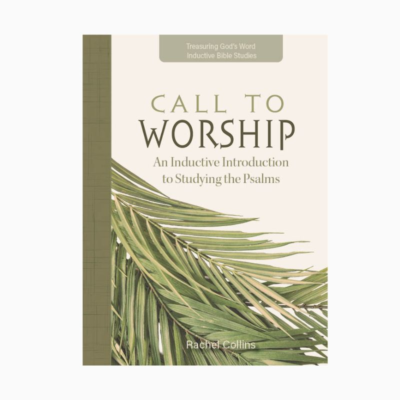
If you’d like some help putting these principles into practice, you can start with a free sample lesson from Call to Worship. It will walk you through an inductive study of Psalm 1, one step at a time, in more detail than what we have done here.
Every time a new person walks into one of my groups I get so giddy thinking of the journey that they are about to begin – and I feel the same way for you now. Learning to study well has helped me walk through difficult seasons, leap out of my comfort zone, and find peace in learning to trust the Lord completely. I can’t wait to hear what the Lord does in your life as you take the time to get to know Him through His Word!